AI + Genomics + Traditional Medicine: where will precision medicine begin in Vietnam?
On the morning of 8 November 2026, as Director of Vinmec Da Nang International Hospital, I met Dr Cao Anh Tuan, co-founder and CEO of LIFE AI, at the company's office in Vietnam's National Innovation Center (NIC) in Hanoi. We did not talk about a piece of software. We talked about a bigger question: now that AI can read genes and predict risk, where will precision medicine in Vietnam begin, and how do we begin without losing sight of the patient?
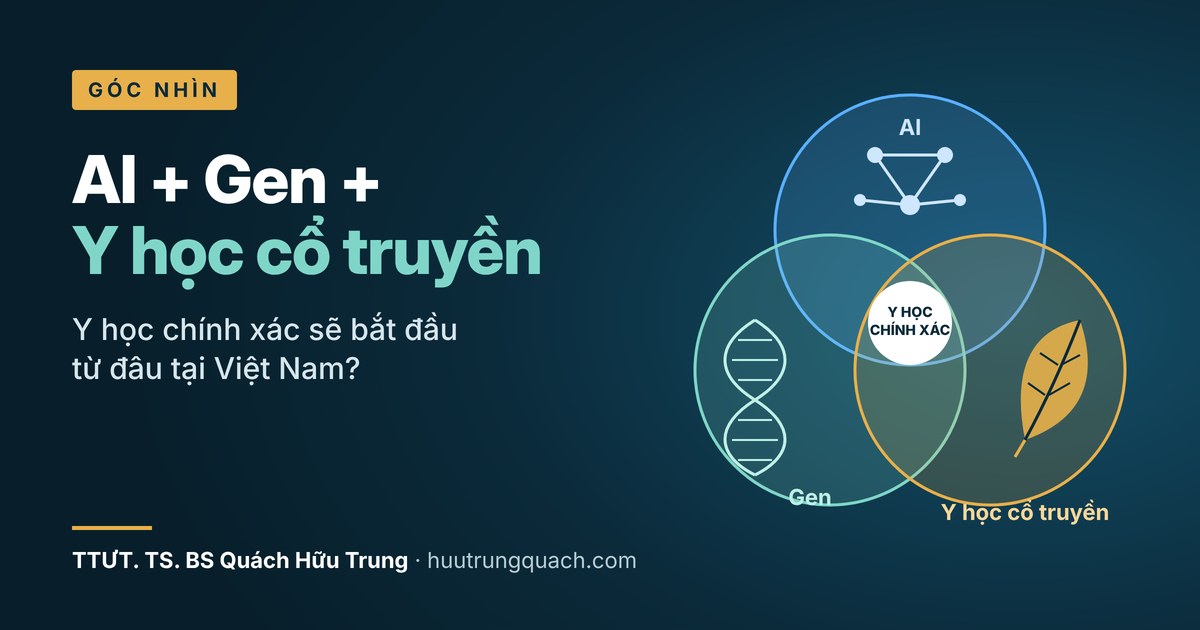
Three key points: (1) AI in hospitals should start with the tasks that take up most of a doctor's time, and give that time back to patients. (2) Genes are not for fortune-telling but for personalising prevention; Vietnam's bottleneck is data, not technology. (3) Traditional medicine is a distinctive advantage, if it is "translated" into the language of data and tested through research.
1. From the patient's question to the system's question
In almost 35 years of clinical practice, I have met many patients who arrive with the same question, phrased in different ways: "Doctor, is this disease in my family's genes? Will I end up like my parents? Will my children?"
In the past, we answered with experience and with probabilities for the population as a whole. Today, we can answer with that person's own data: genes, metabolism, lifestyle, environment and family history.
That is the essence of precision medicine. It is not about more expensive treatment, but about the right treatment for the right person at the right time, and above all about earlier prevention.
At NIC, our conversation revolved around three pieces: AI, genomics and traditional medicine. They seem far apart, but placed side by side they form a picture that is distinctly Vietnamese.
2. AI: not to replace doctors, but to give doctors more time with patients
I often tell colleagues at Vinmec Da Nang that AI in hospitals should start with the most time-consuming tasks.
Every day, doctors and nurses spend a great deal of time re-taking histories, writing notes, entering data and completing records. That is time that should belong to patients.
In "AI in healthcare is not about replacing doctors, but about changing how the whole system makes decisions", I shared this approach. At LIFE AI, the conversation went a step further: AI not only helps with documentation, it also brings data together to support clinical decisions.
Take a 55-year-old patient with hypertension and prediabetes whose father had a stroke at 60. Looking at each indicator separately, we see a "normal" patient. But if AI combines genetic data, HbA1c over time, 24-hour blood pressure, sleep, physical activity and family risk, we can see a risk trajectory taking shape before an event happens.
That is what I am pursuing at Vinmec Da Nang: a healthcare ecosystem in which technology does not stand alone but is integrated into the entire patient journey.
Even so, I always ask three questions before deciding to deploy any technology:
- First: does it reduce time-consuming work for doctors, or does it add yet another data-entry task?
- Second: does it help patients feel heard and reassured? What gives me the most joy is not a successful operation, but patients, wherever they come from, feeling listened to throughout their care.
- Third: can its clinical results be measured? If we cannot measure it, we should not call it innovation.
3. Genomics: not to predict fate, but to personalise prevention
Genetic testing is still widely misunderstood. Genes do not tell your fortune. They help us understand risk and choose the right intervention.
Someone may carry a high genetic risk of diabetes, yet by changing their lifestyle early they can delay the disease for years. Others metabolise drugs differently because of their genes. A familiar example in cardiology is clopidogrel: people carrying loss-of-function variants of the CYP2C19 gene, which are fairly common in Asian populations, metabolise the drug poorly, so its antiplatelet effect is reduced. Knowing this in advance, a doctor can choose the right drug or dose from the start.
Vietnam's biggest problem today is not sequencing technology. We can already do that. The problem is data.
Genomic data on Vietnamese people are still scarce and fragmented. We do not yet have large enough reference databases to say what a given variant means for Vietnamese people, in Vietnam's living conditions, diet and climate.
That is why the meeting with LIFE AI at NIC, home to Genetica's genome-decoding centre, matters. We need partners who understand that genomic data are an asset, but first and foremost a responsibility.
In "Health data: asset or responsibility?", I wrote that data belong neither to the hospital nor to the technology company. They belong to the patient; we are only trustees. This now has a clear legal basis: Vietnam's Personal Data Protection Law, in force since 1 January 2026, classifies health and genetic data as sensitive personal data. Every AI application built on genomic data must start from informed consent, security and transparency about how the data will be used.
If we do this right, Vietnam can move fast, because we have advantages: high smartphone use and a hospital system undergoing rapid digital transformation. If we rush, we will lose trust, the hardest thing to regain in healthcare.
4. Traditional medicine: a difference the rest of the world does not have
This was the part of the NIC meeting I found most compelling.
When the world talks about precision medicine, it usually means genomic data, drugs and research drawn mainly from Western populations. But Vietnam has a treasure few countries have: traditional medicine.
I do not see traditional medicine as opposed to modern medicine. I see it as a body of knowledge about constitution, predisposition and balance, built up over centuries of observing people in a specific environment.
The question is whether AI can help us systematise that knowledge.
For example, a traditional remedy is used for people with a "cold constitution and spleen deficiency". If we hypothesise that a "cold constitution" corresponds to measurable signs, such as a low basal metabolic rate, low blood pressure, sleep disturbance or a characteristic gut microbiome, and then test that hypothesis through research, we will have a common language between traditional and modern medicine.
This is not about replacing traditional practitioners with machines. It is about giving them more evidence, helping young people understand their bodies in scientific language, and helping the world understand the value of Vietnamese medicine.
I believe that if we achieve this, we will not merely be followers in precision medicine; we can build a model of our own: precision medicine with a Vietnamese identity.
5. From NIC back to Da Nang: starting with two or three use cases
NIC connects start-ups, research institutes and hospitals. Hospitals are where clinical validation happens. Without hospitals, innovation stays in the laboratory.
Back in Da Nang, my decision is clear: Vinmec Da Nang will not chase every technology. We will choose two or three use cases, go deep, measure carefully, and only then scale up.
- First: endocrinology and metabolism. This is the field I have devoted my career to: diabetes, obesity and metabolic disorders. It is also where genomics, AI and lifestyle create the clearest value.
- Second: preventive cardiology. This links to our work on sleep apnoea, sleep and cardiovascular risk with Professor Duong Quy Sy.
- Third: healthy longevity. At the Da Nang Longevity Summit & Exhibition 2026 tomorrow, 13 November, I will discuss "Healthy Brain, Healthy Metabolism", following on from "Healthy brain, healthy metabolism: why we need to act earlier". According to the 2024 Lancet Commission on dementia, about 45% of dementia cases could be prevented or delayed by addressing 14 modifiable risk factors, including hypertension, diabetes, obesity and high LDL cholesterol. That is not an abstract figure. It is nearly half of the families who could be spared the pain of watching a loved one begin to forget.
These three directions are not separate. They form one journey: healthy metabolism → healthy heart → healthy brain → healthy longevity.
Conclusion: technology only matters when it makes healthcare more humane
I left NIC with a clear feeling: we face a great opportunity, and an equally great responsibility.
AI can read genes faster than we can. AI can bring together more data than we can. But AI cannot listen to the worries of a mother whose child is ill, cannot hold the hand of an elderly patient frightened before surgery, and cannot replace the trust patients place in their doctors.
My leadership philosophy has not changed: technology only truly matters when it makes healthcare more humane, more accessible and more patient-centred.
If we hold on to that, AI, genomics and traditional medicine will not be three separate stories. They will be one story: of a Vietnamese healthcare system that is modern yet still deeply Vietnamese, where every patient is properly understood, properly cared for and helped to live healthily for longer.
Are you interested in genetic testing or precision medicine? Share your questions; I will pick the most common ones for my next article.
This content is for information only and does not replace individual medical advice.
Further reading
- AI in healthcare is not about replacing doctors, but about changing how the whole system makes decisions
- Healthy brain, healthy metabolism: why we need to act earlier
- Health data: asset or responsibility?
- Sleep apnoea: the missing piece in cardiometabolic care
- What does GHA assess? The before–during–after journey of international patients
This article reflects the author’s personal views and does not represent Vinmec Healthcare System.